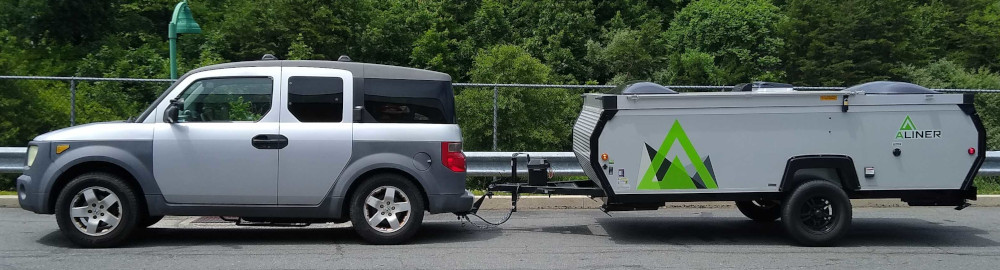
Our Aliner is lightweight, but because our tow vehicle has a very low tow rating, it´s been important to keep the weight of both our baby SUV and our camper trailer at a minimum.
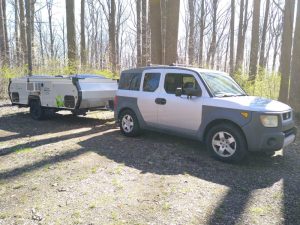
Photo of a gray and black Honda Element and an
Aliner Scout in a wooded campsite.
We did several things immediately to keep these weights down.
As is the case for many, if not most, passenger vehicles, the weight limit for inside our Element is far, far lower than most people realize. If you put four typically-sized USA adults into the average vehicle the size of ours, you´re already well onto the limit, and possibly matching it.
I should note that, combined, we are ourselves under the average weight of US residents, which matters when considering overall weight (vehicle and trailer) while towing. This is an immediate plus when calculating what we can put into the cargo area of our tow vehicle.
To increase our cargo capacity, we removed the rear seats in the Element; they pop out very easily, and we automatically gained a significant advantage in available cargo weight by removing them.
In the camper, we deliberately chose to have no propane, and no heater — and therefore no weight associated with any of these things. Our Scout did come with an air conditioner (22 pounds) which we eventually removed, but no other appliances, so no stove, no fridge and no additional weight there. We do have a battery mounted on the front of the camper chassis (it´s standard, and necessary!) which operates basic lights (and the built-in ceiling fan) inside the camper.
Our model came with a sink — a very attractive sink, which everyone notes is far too small to be useful. It´s not worth the bother to remove it and it´s not metal, so it´s light enough that removing it wouldn´t appreciably lighten the trailer. We´ve left it in place so far.
But I did remove the faucet, which incidentally punched a hole in the curtain above it when we folded the roof, so beware if you have an Aliner with faucet! We don´t store water which is very heavy; we bring the minimum we need for the first day of each trip, and refill as necessary.
Our Scout´s layout has a double bed at one end, and a sofa/dinette at the other. The sofa/dinette can be made into a second, single, bed, but we don´t ever intend to do that, so we removed the boards which make the transition possible. More weight (though not much) gone!
Most people (i.e., those driving a tow vehicle with a much higher tow limit) would be able to leave much of the everyday camping gear in their Aliner when towing; we knew we would need to be a bit more extreme about weight due to our choice of tow vehicle.
As a result, we travel with only the weight of linens (sheets, two duvets) and a few light items in the trailer itself. Our Aliner, with these few things, is as close to the stated USA towing limit on our Element as we want to get.
So we carry our gear in our tow vehicle, all of it, packed in ten or so lightweight plastic bins, not in heavy camping totes. The totes allow for automatic organization of everything, and also, unlike giant bins, are very easy to hand in and out. (The essential ones also tuck nicely under the bed in our Scout once we´re in camp!)
So we´ve thoughtfully removed a number of sources of weight in both tow vehicle and camper. Since we prefer to camp away from resort style sites, or places where electrical hook-ups attract more maximalist campers, these changes have worked out very well for us.
Copyright 2026; All Rights Reserved. This blog is written by a human, without AI input. Please respect the gift offered here of content without cost to you, and do not re-post or copy without permission. No one pays me for this content, and I have no commercial, or other, affiliation with any product mentioned here.