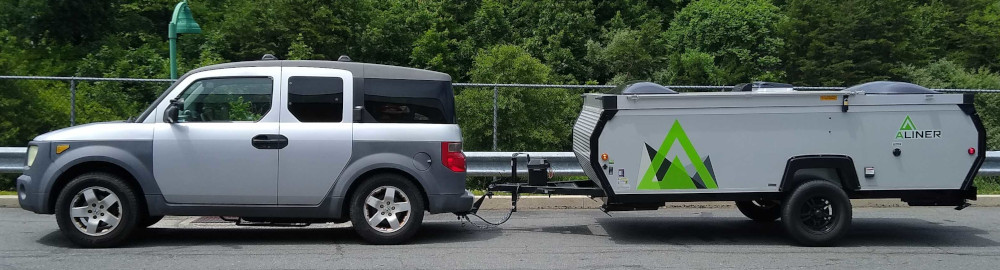
There is a huge amount of information about towing a camper on the internet, most of it confusing and contradictory. If you have a massive truck, you´ll likely not have to think twice about towing a light camper like an Aliner. If you drive an elderly Element, as we do, you probably need to think very carefully about what you are doing.
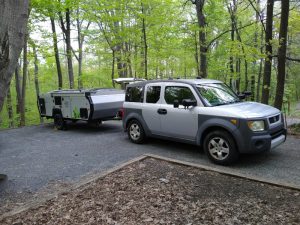 Photo of a folded Aliner Scout backed into a campsite
behind a gray and black Honda Element
I´m not going to cover any specifics about all of the various methods of figuring out
what´s a safe weight to tow: tongue weight, various ratings, or so on. All I will cover here is how we determined if we felt that we could tow our Aliner Scout safely. Your mileage (quite literally) may vary!
First of all, we made some beginning assumptions. We accepted that towing an Aliner with our particular vehicle meant that we would not be barrelling down the road, hurtling from place to place. That works for us; we dislike highway driving, and knew we´d stick as much as possible to back roads.
For us, the journey is as important as the destination; we want to enjoy it, not rack up miles racing down concrete.
Before buying our camper, we checked the recommended tow limit for our vehicle, the weight of our prospective Aliner, and the recommended appropriate tongue weight. We are OK on all these metrics, but right at the top of the recommended limits. We are in this for the long haul, so we looked carefully at what this meant for us.
We also understood that the cargo weight capacity in passenger vehicles includes the weight of the passengers, and is much lower than almost anyone realizes.
We are aware that some people believe the tow limit for our vehicle is much higher in Europe — even though it´s the same vehicle. This is probably not the case; it seems to derive from confusion involved in translating lbs to kgs and vice-versa.
But it might be worth noting (just in case) that European drivers behave quite differently than do USA drivers. And speed limits for towed campers are much lower in Europe than in the USA. No one in Europe is going to scream down the Autobahn towing a camper, or carry on at standard USA highway speeds with a trailer following.
Whether or not there a higher tow weight limit in Europe, it´s interesting to consider that because stress and safety are different matters in different geographies, the stress on the tow vehicle isn´t necessarily the same elsewhere as it can be in the USA.
Considering these factors, regardless of European/USA tow load rating differences, made us feel a little more confident about being at that upper limit, but also means that we accept that we must take a number of steps to ensure the outcome we want: safe, predictable towing.
We take those back roads; we limit our speed to 55 or below; we stay on top of the mechanics; we make sure to do frequent oil changes and fluid checks to ensure that our Element is in top shape; we are religious about tire pressure on both vehicles; we don´t travel in excessive heat; we watch RPMs closely when climbing, and are fine about taking whatever measures we might need to keep those RPMs where they belong.
Our hitch is fitted with a sway bar, which seems to give us great control in transit, and it´s probably one of the reasons that we can hardly feel the trailer behind us. In the beginning, we kept looking back because we couldn´t believe there was a camper attached, and, even now, it´s still surprising to realize how little difference there is between driving the Element with and without the Aliner attached.
In addition, we make sure that we keep the weight down for everything in our Element, and in our camper, and that the weight is appropriate for each vehicle. (More in another post.)
Our 2025 Scout has its own trailer brakes, and this, too, is both a safety measure and another way to reduce wear on our tow vehicle.
In addition, the truth is that campers are made very badly, and not made to last. An Aliner — and we can see it with ours — is much better made than most, but it´s still made of the thinnest plywood possible (practically like paper in some places!), and held together as with as little hardware as possible.
Road vibrations are very, very hard on campers. We keep our speed down to preserve both our tow vehicle and to help keep our camper in the best shape possible. We´re just fine with that.
We´re two seasons into our Aliner experience so far, and this approach has served us well, and hopefully will continue to do so!
Copyright 2026; All Rights Reserved. This blog is written by a human, without AI input. Please respect the gift offered here of content without cost to you, and do not re-post or copy without permission. No one pays me for this content, and I have no commercial, or other, affiliation with any product mentioned here.