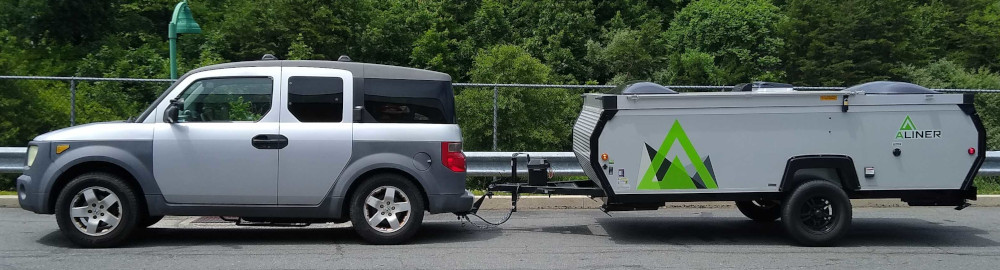
As previously noted, we have had no serious issues with our Aliner, which has been a wonderful surprise, given how camper life goes in general. But we have had two issues with a cabinet door.
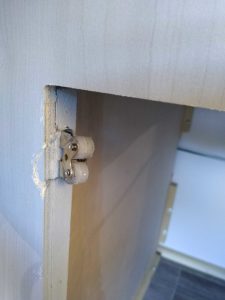
Photo of a damaged hinge catch and cabinet frame. The catch
is bent sideways (and now useless!), and the side of the cabinet
has been battered by the harp clip which was meant to connect
with the nylon rollers on the catch. The battering occurred while the
camper was traveling merrily down the road after the door flew open.
The first was a minor, but very annoying, problem with the catch. When it was installed, someone over-drilled, and the catch couldn´t be tightened so that it didn´t spin. When it spun, the catch wouldn´t latch onto the nylon rollers inside the cabinet, which meant that we had to hold it in place every time we closed it.
I solved that problem — only temporarily, as it turned out — by jamming a strong adhesive paste between the catch and the cupboard door. This has worked reasonably well, but, as a solution, it´s a bit galling. And slightly messy.
Annoyingly, as you can see above, the catch eventually slipped again and ripped up the side of the cabinet.
We then discovered that the cupboard door was no longer functional. The door had vibrated open on the long ride home, and the upper hinge had nearly ripped itself off the cabinet.
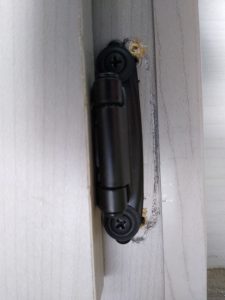
Black replacement hinge showing original
hinge holes to the right.
In the process, the hinge warped, and became unusable. When I looked inside the cabinet, I discovered that the vertical supporting strut which was meant to hold the hinges in place had been installed too far from the cabinet face: The hinge screws only reached through the cabinet wall — which is essentially cardboard — and not into the strut.
This was both dumb and careless. (And it´s exactly the kind of build camper owners constantly encounter.) A check of the other cabinets revealed, though, that all the others appear to be fine, so our only issue seems to be this one door.
I emailed Kevin at Aliner, who is hugely helpful, and, in a few days, got a friendly response from him, and a note that he was sending replacement hinges. (Kevin is another reason we were happy to buy an Aliner! We´d asked pre-purchase questions, and knew a human, and a pleasant human, was behind the company!)
The fix did not require moving the strut, which was a very good thing. I went to a hardware store and bought longer screws, and spent some time on hands and knees getting the door re-hung. We now have an unsightly set of unused holes in the cabinet frame, which is too bad, but there are worse problems in the world. And the door now works.
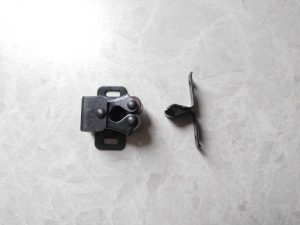
Photo of black replacement cabinet catch.
The catch has flat rollers, and an arrow-style clip
that connects with two nylon rollers in the catch body.
The catch was irredeemable, and had to be replaced after it ripped itself apart. I bought a new catch, carefully choosing one that didn´t have a clip dependent on one screw. This latch is also cheap, but looks a bit sturdier than the original. Time will tell. At least the design is a whole lot more sensible than a single screw for the harp, which effectively guarantees that the clip will spin, eventually if not immediately.
A significant annoyance, though, was that the original cabinet catches are installed with square head screws, meaning that a square head screwdriver is required. Naturally, I installed the new catch with conventional screws — I´m not thrilled at having to reach for a specialty screwdriver for repairs. (Though you do want a square head screwdriver in your Aliner tool kit. Square head screws abound, and if you need it, it’s better to have the driver than not.)
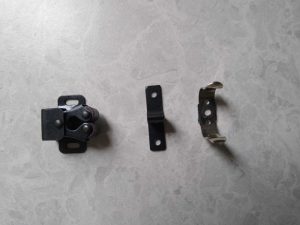
Photo of a lack replacement catch and (center) the
connector, showing two screw holes. To the right is the
silver harp clip which was original to the Aliner.
It attaches with a single screw, which is allowed
the clip to spin and cause a bunch of petty damage.
Naturally, we don´t trust the cabinet catches any more. They are light and simple, and we are loathe to change them for the same reason Aliner probably chose them in the first place: Hardware is heavy. We don´t want the weight of sturdier ware, but on the other hand, I never want to re-hang a cabinet door again.
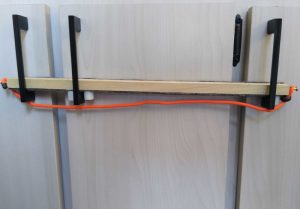
Photo of a wooden rod, backed with hardly-visible gray felt
which is slotted through three cabinet handles. A large orange
vinyl twist-tie runs under the rod to keep it from riding up when
in transit.
We went for the primitive (and ugly) fix: It´s a wooden rod, backed with felt so that the cabinet doors don´t get scraped.There are three screws, set through nylon spacers, two bracketing the middle cabinet handle, and one capturing the handle on the right. A vinyl coated wire wrap runs underneath to keep the rod from riding up and flying out.
It will get cleaned up at some point. It´s painful to see something so crude in our Scout! On the other hand, we toss this bar into a cabinet while were camping, and that screaming orange wrap makes sure we remember to install the lock when we break camp.
We´re relying on hope and magic for the other doors on the other side, which so far have maintained. Just the same, I bought replacement catches for all the doors. If another one fails, we´ll be ready.
Copyright 2026; All Rights Reserved. This blog is written by a human, without AI input. Please respect the gift offered here of content without cost to you, and do not re-post or copy without permission. No one pays me for this content, and I have no commercial, or other, affiliation with any product mentioned here.